|
Picture Disease/Disorder |
|
[Alternaria] [Anthracnose] [Bacterial
canker]
[Black Spot]
[Black
Spot On citrus] [Black Spot
on pawpaw] [Black Spot
on roses] [Blossom
End Rot] [Catface
deformity] [Cercospora
spot]
[Crown Gall]
[Damping Off]
[Dieback]
[Downy
Mildew] [Fasciation] [Fleck]
[Fruit splitting]
[Grey Mould]
[Gummosis]
[Herbicide
damage] [Leaf
curl on peaches] [Leaf
spot] [Leaf
spot on hippeastrum] [Melanose
on citrus]
[Nematodes] [Phosphorous
induced iron deficiency] [Phyllody]
[Pinks disease] [Powdery
Mildew] [Rust]
[Rust on frangipani]
[Rust on lawns]
[Rust
on myrtaceae-Myrtle
Rust] [Scab]
[Scab on citrus]
[Scab on
passionfruit] [Scab
on potatoes] [Sooty
Mould] [Stylar
End Rot] [Target
Spot] [Woodiness virus on passionfruit]
[Wilt]
[Vivipary] |
|
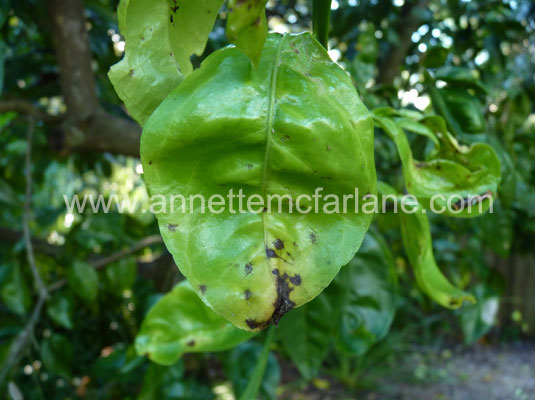
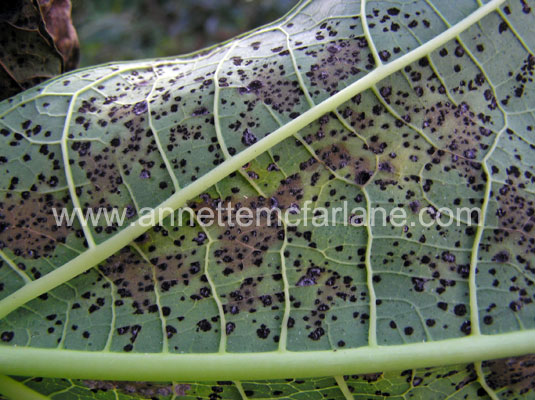
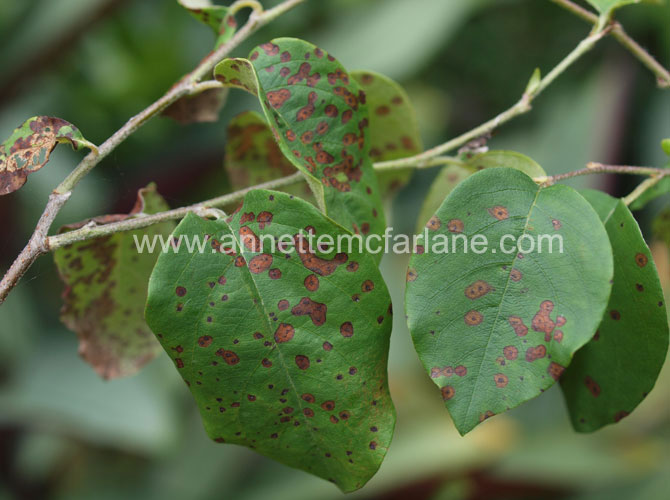
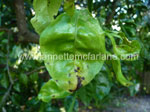 Alternaria Alternaria
This fungal disease is a common, but rarely diagnosed
disease of back yard fruit. Symptoms may include large
leaf spots (pictured); increased leaf drop; tip dieback;
brown spots edged in yellow on fruit skin and/or
internal fruit rot.
This disease occurs rapidly during mild temperatures
with high humidity and/or during rainy or misting
conditions. Avoid wetting foliage when watering. Prune
dead and damaged foliage and increase air circulation
and exposure to direct sunshine. Avoid fertilizing
during periods that favour the disease as new growth is
particularly susceptible.
Apply casuarina tea [see Do It Yourself Pest Control];
commercial liquid silica and potash or copper-based
sprays. Lemons, mandarins, tangelo, oranges and related
citrus are commonly affected. Brown spots on fruit of
passionfruit are symptom of Alternaria passiflorae.
Parsley is affected by Alternaria petroselini. |
|
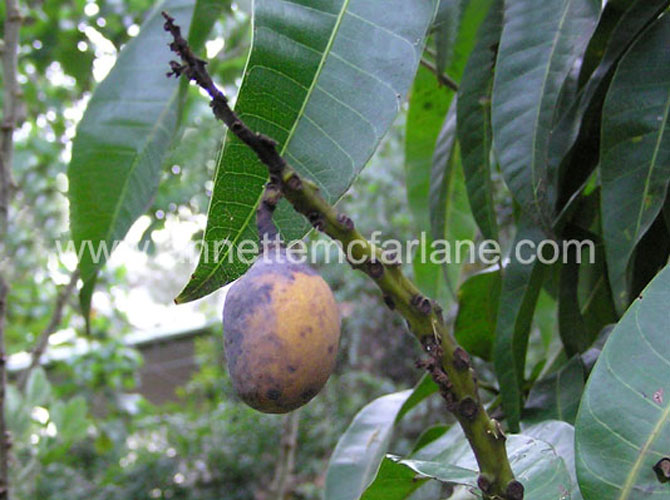
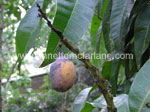 Anthracnose Anthracnose
Anthracnose (Colletotrichum species) is a fungal
disease exacerbated by rain and high humidity. During
dry weather the disease is virtually absent. This
disease is the primary reason why mango, avocado,
banana, custard apple, lychee, macadamia, passionfruit,
carambola and fruit fail to develop or develop fruit
that blacken and drop prematurely. Skin of citrus fruit
may be affected although flesh generally remains edible.
Apply casuarina tea [see
Homemade pest control];
commercial liquid silica and potash; copper-based sprays
immediately prior to flowering and during early fruit
set to reduce the effects of anthracnose. However, these
preparations rarely control the disease if rain and high
humidity persist to favour disease development. Where
possible, investigate fruit tree varieties with some
degree of natural resistance to anthracnose. |
|
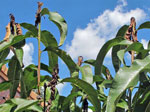 Bacterial
canker (Pseudomonas species) Bacterial
canker (Pseudomonas species)
Sunken dead patches on stems; shot-hole on leaves; stem
dieback and/or oozing of sap from the trunk and branches
are common symptoms of bacterial canker. The disease is
particularly prevalent on stone fruit. Make clean cuts
when pruning to avoid tree damage. Clean pruning tools
with disinfectant between cuts or at least between
individual trees. Avoid pruning in winter when trees are
more vulnerable due to slow callus growth and
environmental conditions that support disease growth.
Remove badly affected trees. Use commercial tree wound
dressings or biodynamic tree paste [see
Homemade pest control]
or apply a copper-based spray during winter. |
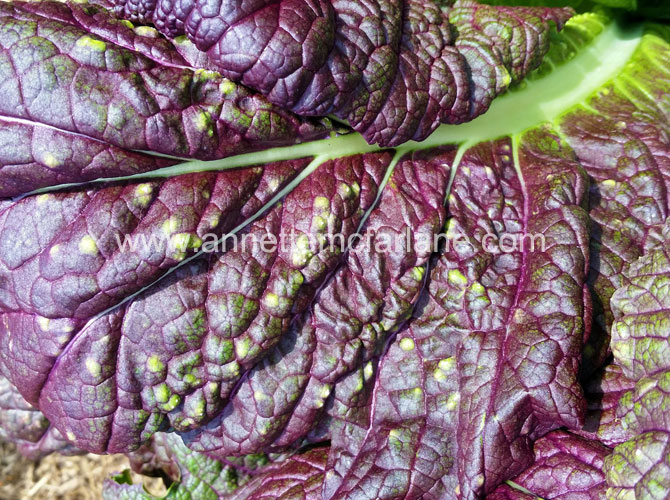
Black Spot
Black spot describes the symptoms of a range of
bacterial and fungal diseases affecting ornamental and
productive plants. |
|
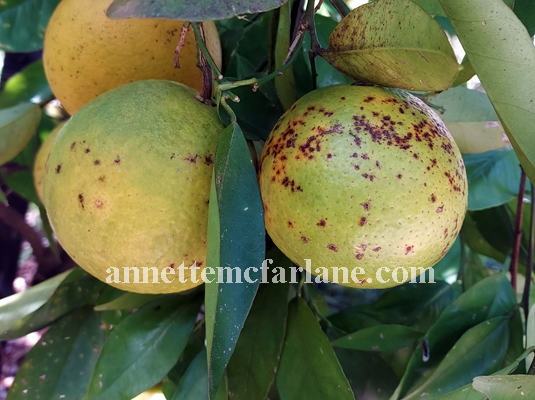
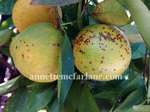 Black
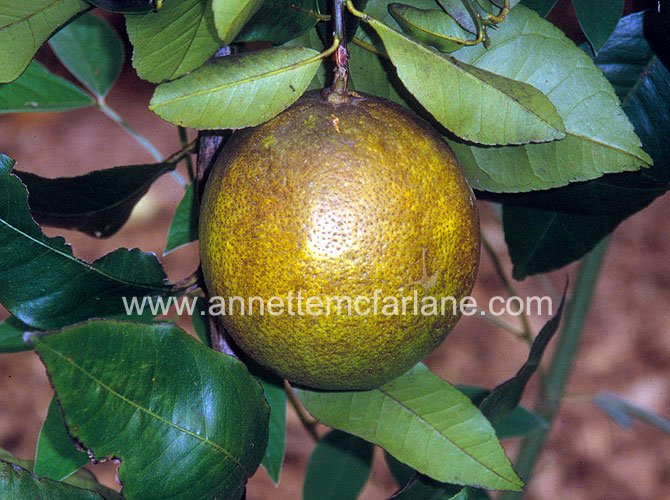
Spot on Citrus Black
Spot on Citrus
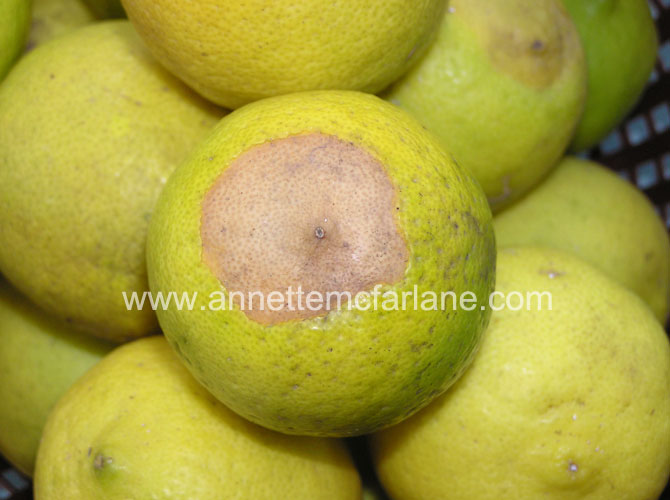
Black spot fungal disease (Guignardia citricarpa)
is a common disease in humid climates. The disease takes
on different types of symptoms on affected citrus fruit
including freckle spot (pictured here), speckled blotch
(more generalized skin damage which resembles mite
infestation) and hard spot (crusty circles). To minimize
outbreaks, pick up all fallen citrus and cut off
affected fruit, then dispose of off-sight. Clean away
dead twiggy growth to open trees to better air
circulation. Make sure your nutrition regime includes a
balance of trace elements. Supplementary foliage sprays
of liquid Silica and Potash (Plant of Health) can help
build disease resistance and may be sufficient to
prevent outbreaks. Alternatively, spray with a
copper-based product (like organic Bordeaux) just prior
to flowers opening, and again when fruit are young
(especially if your trees have been affected in previous
seasons). Wash harvested fruit in soap and water or wipe
with a disinfectant cloth to prevent the disease
occurring post-harvest in your fruit bowl. |
|
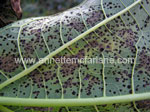 Black
Spot on Pawpaw Black
Spot on Pawpaw
Fungal infections of
Asperisporium caricae cause this
disease. Natural plant genetics and nutrition are
important factors in disease control. Grow plants from
seed of pawpaw local to your region. Increase potassium
(sulphate of potash and/or lucerne mulch), phosphorous
(rock phosphate or chicken manure) and magnesium levels
(Epsom salts) to make plants more disease resistant.
Incidence of the disease increases during the cooler
months when nutrient uptake slows. Apply liquid seaweed
to increase nutrient availability and improve cold
tolerance.
Apply casuarina spray; bicarbonate of soda sprays [see
Homemade pest control];
commercial liquid silica and potash; wettable sulphur or
copper-based sprays prior to the onset of and during the
cool weather. Wash ripe fruit in water as hot as your
hands can stand and dry thoroughly to control fungal and
bacterial spores that cause post-harvest fruit rot. |
|
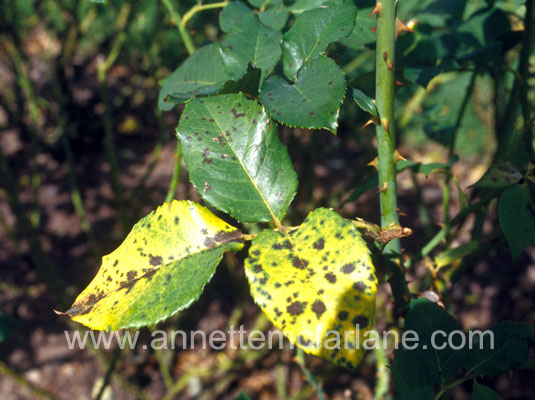
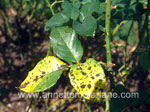 Black Spot on Roses Black Spot on Roses
The causal agent is the fungus Diplocarpon rosae. Full
sun and good air circulation are essential in combating
this disease. Avoid wetting the foliage. Water early in
the day. Provide balanced nutrition. Apply foliage
applications of seaweed and/or commercial liquid silica
and potash to increase disease resistance. Fish-based
fertilisers also contain trace elements valuable in
building disease resistance. Remove infected leaves and
collect fallen leaves from beneath plants. Prune out old
canes and diseased wood. Dispose of diseased material
offsite. Apply bicarbonate soda sprays [see
Homemade pest control-Bicarbonate of Soda Spray]; wettable sulphur or commercial
potassium bicarbonate products (Eco-Rose). Contact your
local rose society for recommendations of disease
resistant rose cultivars.
Black spot on citrus is caused by the fungus Guignardia
citricarpa and results in freckle and blotches on fruit.
Bacterial black spot on mango is caused by Xanthomonas campestris
mangiferaeindicae. For management of these diseases
follow guidelines as for pawpaw and roses. |
|
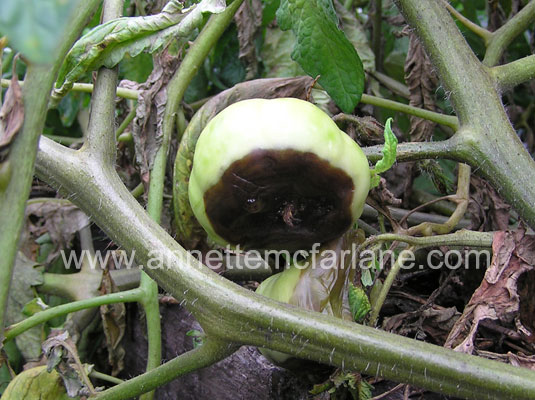
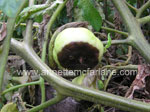 Blossom
End Rot Blossom
End Rot
This disorder has two contributing causes
- calcium deficiency and irregular watering. When
planting tomatoes, capsicum, chilli, tamarillo and
related solanaceae plants add calcium in the form of
gypsum (powdered or liquid form) or if the pH of the
soil is acidic, apply Dolomite lime. Ensure regular
watering. Affected fruit cannot be saved and should be
removed. If plants are affected early in the growing
season, it is possible to apply calcium and improve
watering practices to achieved improve the fruit harvest
later in the season. |
|
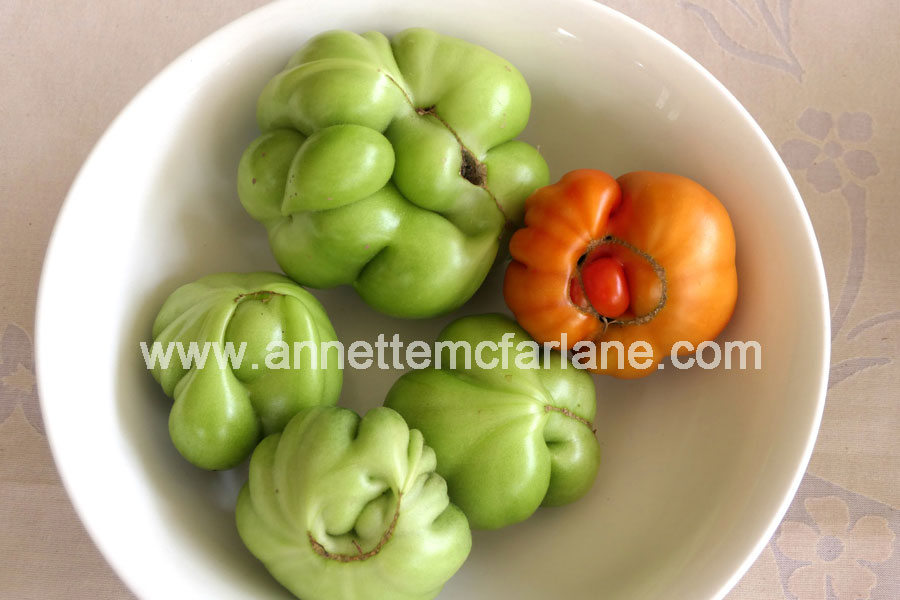
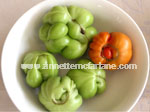 Catfacing
deformity on tomatoes Catfacing
deformity on tomatoes
Catfacing deformity on
tomatoes is a natural characteristic of some heirloom
varieties - part of their character. In other instances,
fluctuating temperatures are to blame, particularly very
warm days (30 degrees) followed by cooler nights (10-12
degrees). Fruit that form on the same plant outside the
temperature fluctuations are generally unaffected. Mite
and thrip infestations at flowering and first fruit set
also contribute to catfacing. Nutritional imbalance,
particularly overfeeding with nitrogen increases the
incidence of the disease, often affecting the entire
crop. Affected tomatoes can be left to ripen and are
perfecting safe to eat. Alternatively, you can use them
to make sauce, chutney and pickle. |
|
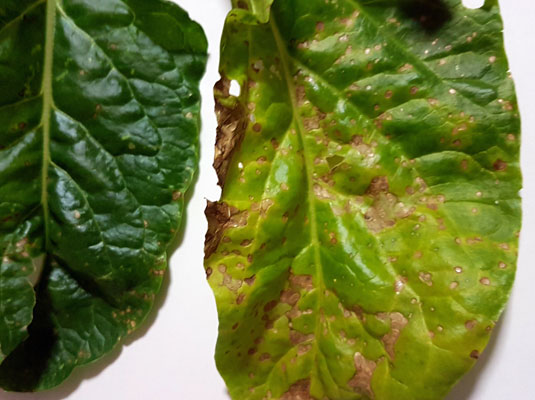
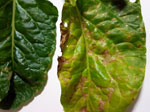 Cercospora spot/ Pseudocercospora spot Cercospora spot/ Pseudocercospora spot
Environmental conditions play a major role is these
fungal disease outbreaks. Cercospora spot is
particularly virulent on leafy greens including spinach,
silverbeet, lettuce, beetroot and rocket and also
attacks succulent plants like yucca. To avoid disease
outbreaks by ensure plants have full sun and great air
circulation; apply liquid seaweed; avoid watering late
in the day; avoid excess nitrogen (overly rich manure,
fertilizers) and balance nitrogen with extra commercial
liquid silica and potash and trace elements from rock
dust or commercial products. Preventative bicarbonate of
soda or milk sprays [see
Homemade pest control] or
commercial sprays based on potassium bicarbonate like
Eco-fungicide help minimise disease outbreaks on soft
leaf plants.
Corky blisters on fruit surface of avocado is caused by
Pseudocercospora purpurea; Black spots on the leaves of
coffee plants results from Cercospora coffeicola.
Pseudocercospora annonicola attacks foliage and fruit of
custard apples. Pseudocercospora macadamiae affects
foliage and fruit of macadamias. Bacterial black spot on
yucca is caused by Cercospora yucca.
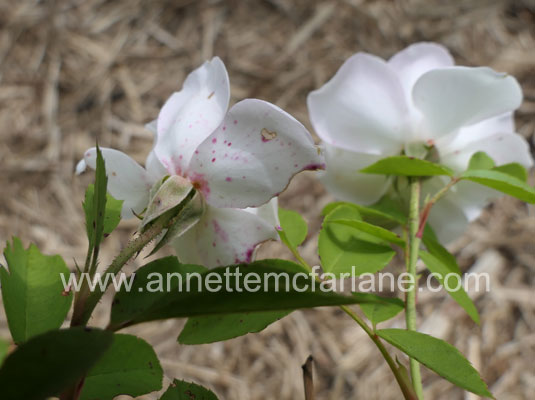
Follow general recommendations above. |
|
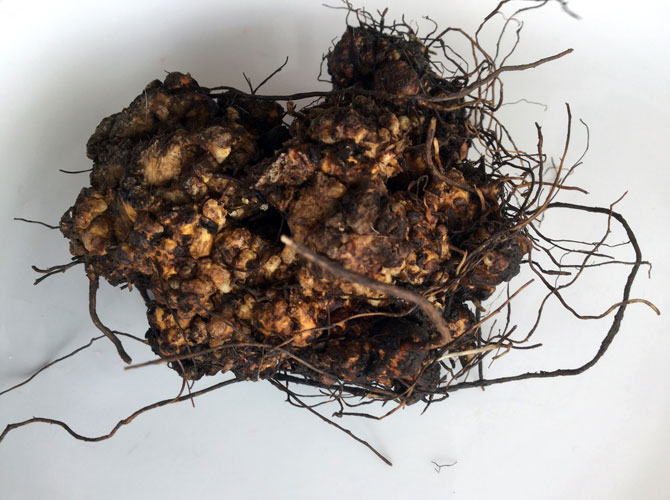
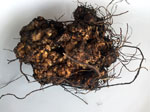 Crown Gall Crown Gall
This bacterial disease (Agrobacterium tumefaciens)
potentially affects a wide range of ornamental and
fruiting trees, shrubs and vines. Bacteria are
persistent in the soil and enter plants via a wound.
Galls develop on the below ground stems and roots. These
increase in size over time, affecting the growth and
vigour of plants. They can eventually reach an enormous
size, but often go un-noticed until the plant is
removed. There is no treatment for existing infected
plants. Avoid planting back into gardens where crown
gall has previously occurred.
Prior to planting susceptible species like roses, soak
new plants in beneficial mycorrhizal fungi specifically
designed to provide protection from crown gall.
Proprietary brands include NOGALL which was developed in
Australia, but home gardeners may find it very difficult
to source this product. Contact your local rose society.
Please note mycorrhizal fungi have no curative effect on
plants that are already infected. |
|
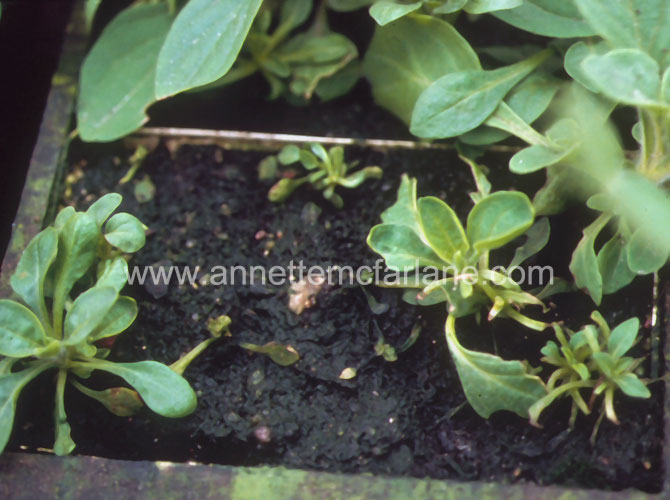
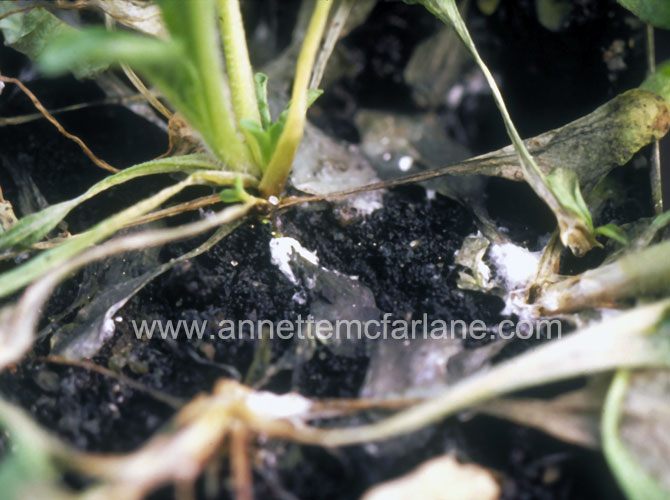
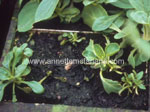 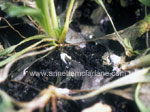 Damping off fungus Damping off fungus
This disease is caused by one or more fungal pathogens.
It affects germinating seeds and young seedlings. It is
transferred via water and affects the water conducting
tissues of the plant. Use new seed raising mix or sieved
compost made using a hot/aerobic method. Wash all pots
and tools in hot, soapy water then allow to dry in the
sun before use or soak in household disinfectant for 20
minutes. Make sure mix and pots are well drained. Never
sit pots in water. There is no cure for affected plants
and they should be disposed.
Newly planted seedlings may appear to suffer from
damping off when the real cause may be over watering; or
planting into soil where excessive fertiliser or rich
compost/manure have been applied; or pests such as
cutworm and wireworm are present [See
picture the pest]. |
|
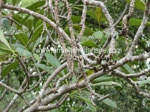 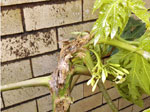 Dieback Dieback
Black tip fungus and stem dieback on pawpaw and
frangipani result in failure to flower/fruit and
withered branches. Tip dieback on pawpaw is most common
during the summer months. Stem dieback occurs in summer,
but is particularly obvious on frangipani during winter
when the majority of species are deciduous. Fruit
piercing/sucking moths and fruit spotting bugs have been
implicated in these diseases. They create entry wounds
and transfer disease organisms to the stems and branches
of plants.
Minimise outbreaks by planting in full sun and ensuring
soil is well drained. Provide balanced nutrition,
particularly in terms of calcium (gypsum); silica and
potash and trace elements. Prune damaged stems back to
healthy tissue and dispose of prunings off-site. Where
possible control moth populations over the summer
months. |
|
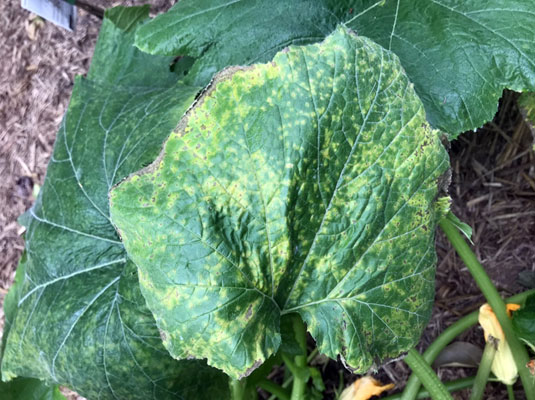
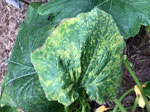 Downy mildew Downy mildew
This fungal disease affects a wide range of vegetables
(particularly cucurbits) and fruit (grapes). Cool, wet
or humid conditions favour disease development as does
nutrient imbalance (excess nitrogen), lack of sunshine
and air circulation and varietal susceptibility.
Zucchini, pumpkins and cucumbers are particularly
susceptible on cooler conditions. Grapes affected early
during the season require treatment, but less so late in
the season prior to leaf drop.
Downy mildew on roses is caused by Peronospora sparsa.
Angular blotches on rose foliage are symptomatic.
Apply bicarbonate of soda spray [see
Homemade pest control]
or use commercial organic fungicides based on potassium
bicarbonate Eco-Carb or Eco-Fungicide. If the underlying
causes of the condition cannot be changed, control will
be limited. This disease is commonly confused with
powdery mildew, but is more difficult to control.
|
|
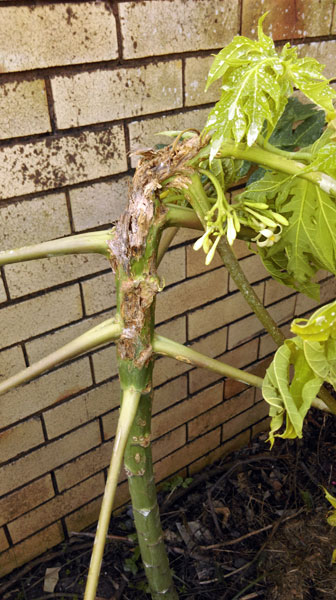
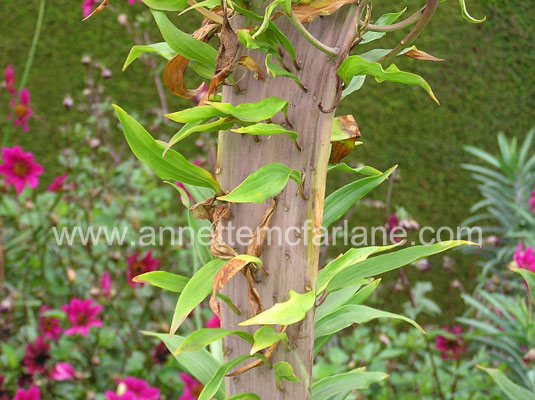
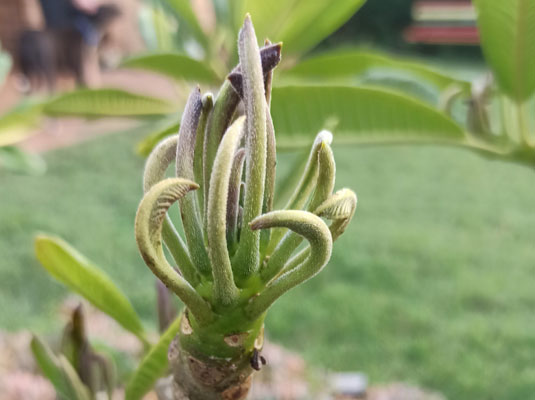
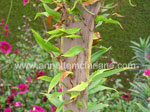 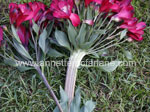 Fasciation Fasciation
This describes an abnormality that results in flattening
of the stem and shortening of internodes or similar
deformities on flowers and seed pods. It occurs randomly
and is generally regarded as a curiosity. Prune off the
affected stem. It is unlikely that the plant will
continue to produce fascinated stems following pruning.
However in some cases, fasciation dominates a plant’s
growth and commercial growers capitalize this weird
growth habit by propagating plants by cuttings or tissue
culture to maintain the fascinated appearance. Examples
include plants with crested flowers or stems. |
|
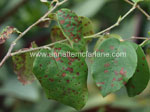 Fleck Fleck
This fungal disease is caused by Fabraea maculata. It
attacks pome or pip fruit like apples, pears and quince
trees. This disease causes serious defoliation; tip
dieback; tree weakening; negatively affects flowering
and fruiting and disfigures and marks fruit. Some
varieties are more resistance. Ask staff at your local
nursery for varieties best suited to your region. This
disease becomes most apparent over summer, but
preventative action must be taken during winter and/or
at first bud burst. Apply seaweed products; increase
silica and potassium levels to aid disease resistance
and/or apply copper-based sprays. |
|
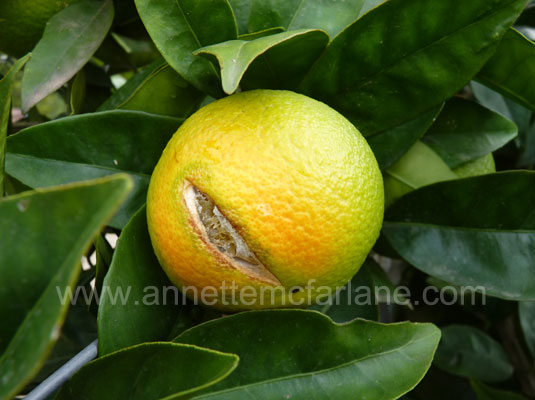
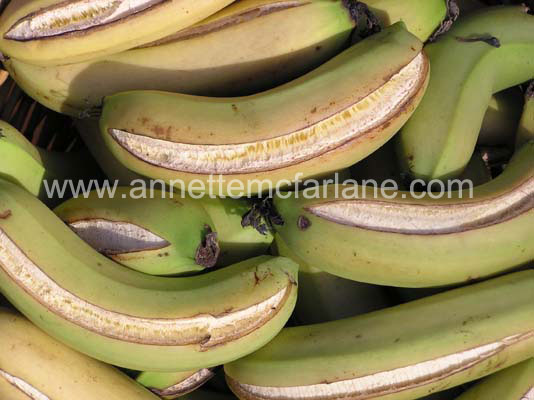
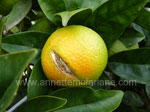 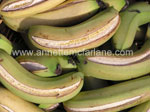 Fruit splitting Fruit splitting
Fruit splitting is common to a wide range of ripe and
unripe fruit and results from irregular watering. To
overcome this problem, water deeply during periods of
low rainfall. Be sure to irrigate beneath and beyond the
full canopy of trees and along the full extent of
foliage on wine crops. Mulch trees and vines well to
help maintain soil moisture level. Apply a wetting agent
and/or liquid seaweed where soil has become water
repellent. Incorporate plenty of organic matter into the
soil prior to planting to help the soil hold moisture.
|
|
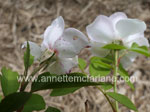 Grey mould Grey mould
Cool temperatures, long periods of rainfall or high
humidity favour development of the fungal pathogen
Botrytis cinerea. Affected flower buds initially display
pink spotting on petals and blooms may fail to open. The
distinctive grey mould becomes obvious as the disease
progresses. Most flowers are potentially vulnerable.
Prune off and dispose of disease affected plant material
offsite. Avoid overhead watering. Improve air
circulation, sunlight and warmth. Apply seaweed
products; increase silica and potassium levels to aid
disease resistance and/or apply wettable sulphur or
copper-based sprays. |
|
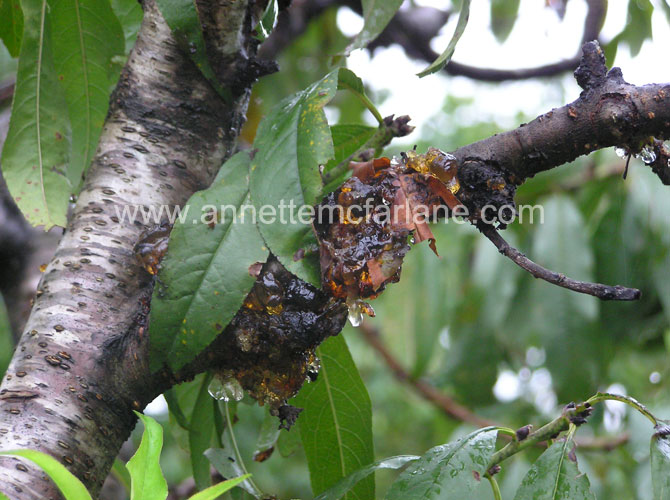
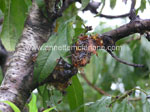 Gummosis Gummosis
Gummosis is a bacterial canker disease that appears as
an oozing gummy residue on trees. Injury caused by
pruning, insects or environmental stress can cause trees
to become infected, particularly stone fruit. Clean the
infected area as much as possible and seal wounds with a
biodynamic tree paste, commercial tree paste or spray
with Bordeaux (lime and copper sulphate). Make clean
cuts when pruning to avoid tree damage. Clean pruning
tools with disinfectant between cuts or at least between
individual trees. Phytophthora root rot caused by poor
drainage or over watering can present similar symptoms
to gummosis. |
|
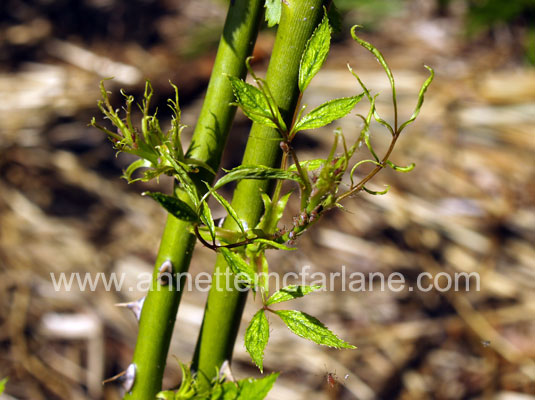
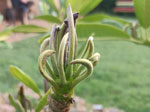 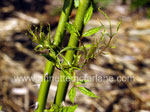 Herbicide damage Herbicide damage
Spray drift, accumulation of herbicides in the soil and
movement of herbicides through soil in water causes
stunted growth and distorted shoots. Glyphosate; Once A
Year Path Weeder; Weed and Feed products that attach to
a garden hose and selective herbicides designed to kill
broad leaf weeds and clover in lawns most likely to be
responsible for the damage. All plants are potentially
affected. Once contact is made with plant tissue, it
cannot be removed. The plants will never grow out of the
damage even if pruned and fertilized. Remove damaged
plants. |
|
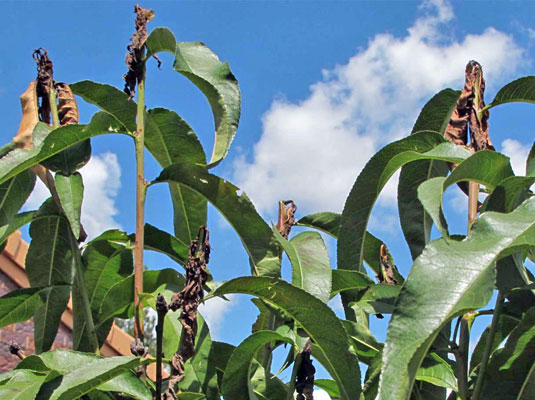
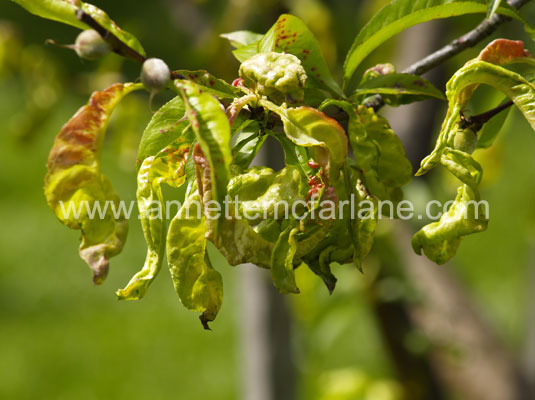
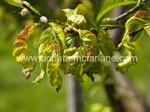 Leaf curl on peaches Leaf curl on peaches
This fungal disease is very familiar to cool climate
gardeners and warm climate gardeners growing low chill
peaches and nectarines. Affected leaves pucker and turn
brown/red. The key to control is growing strong,
vigorous plants (apply seaweed, trace elements, gypsum
for calcium) and using preventative fungicide sprays
like copper when plants dormant or just begin to break
into leaf. |
|
Leaf spot – See also alternaria; black spot;
cercospora spot/pseudocercospora spot
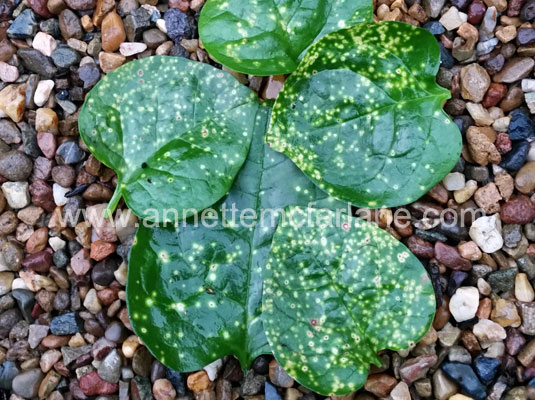
Leaf spot describes the affects of both bacterial and
fungal diseases. Bacterial diseases often create a
see-through window or holes within affected leaves.
Bacterial soft rots cause by Erwinia caratovora cause
lettuce to rot and spotting on Basella rubra. Erwinia
and other associated bacterial diseases occur on
orchids, zygocactus and other fleshy plants. Affected
tissue has a terrible odour. Zanzibar Gem affected by
Xanthomonas campestris develops water-soaked spots.
Basil is susceptible to Pseudomonas species, while parsley is
attacked by the fungus Septoria petroselini. Bacterial
diseases also cause stem and root rot.
Remove the affected leaves or remove badly affected
plants. Avoid watering late in the day or during cold
weather. Grow seasonally appropriate vegetables and look
for disease resistant varieties. Increase sunlight and
avoid overwatering. Ensure plants receive balanced
nutrition including calcium and potassium. Apply
preventative sprays of casuarina, bicarbonate of soda
and milk sprays [see
Homemade pest control] or use
liquid silica and potash or commercial organic
fungicides based on potassium bicarbonate like Eco-Carb
or Eco-Fungicide. |
 |
 |
|
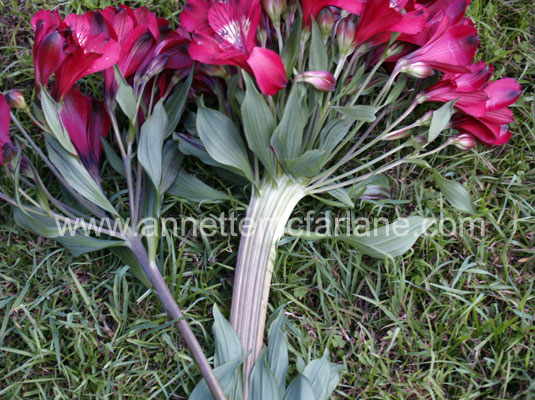
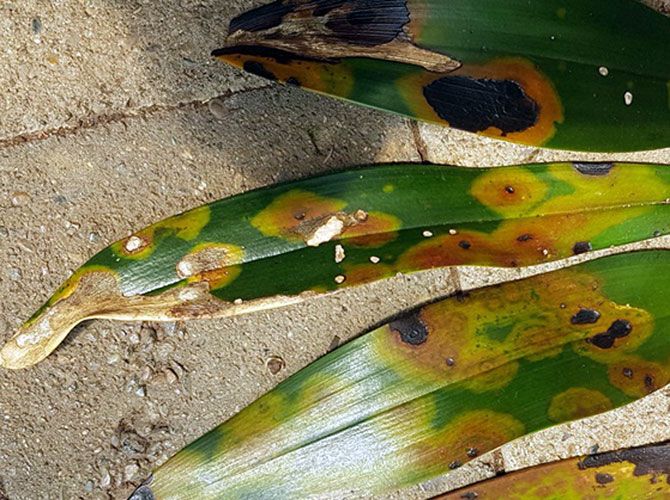
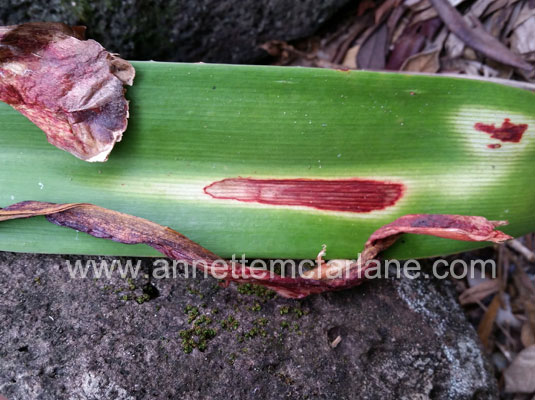
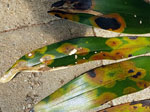
Leaf
spot on hippeastrum
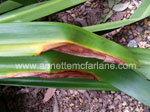 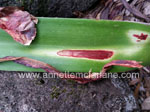 Red blotch fungi (Stagospora
curtisii) that attacks the leaves of hippeastrums
and other bulbs indicates unsuitable growing conditions
including bulbs being planted to deeply, overwatering
and/or excessive shade. This disease is most prevalent
during the cooler months of the year or during periods
of prolonged heavy rainfall. Other bulbous plants are
affected by similar conditions. Change the growing
conditions to make bulbs less susceptible. Remove
affected foliage. Red blotch fungi (Stagospora
curtisii) that attacks the leaves of hippeastrums
and other bulbs indicates unsuitable growing conditions
including bulbs being planted to deeply, overwatering
and/or excessive shade. This disease is most prevalent
during the cooler months of the year or during periods
of prolonged heavy rainfall. Other bulbous plants are
affected by similar conditions. Change the growing
conditions to make bulbs less susceptible. Remove
affected foliage. |
|
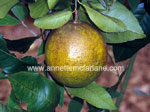 Melanose
on citrus Melanose
on citrus
This disease typically affects more mature trees with
foliage close to the ground. Mulch trees with a feeding
mulch such as lucerne to prevent spores splashing up
onto the foliage when it rains. Lift the lower branches
so that foliage is well clear of the soil. Improve
general tree health with additional organic nutrients
and water.
Spray trees with copper-based compounds after all fruit
has been harvested, thoroughly wetting the foliage,
trunk and branches. Repeat applications once each year
until no further evidence of disease exists. Melanose on
citrus is easily confused with brown rust mites which
create a similar brown discolouration of the skin, but
mites are easily controlled with oil sprays. |
|
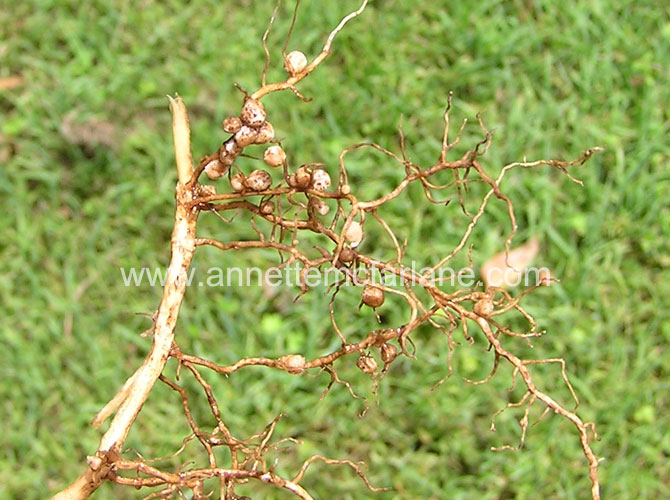
Nematodes
Nematodes are microscopic animals found in the soil,
within plant tissue and within water. Some nematodes are
damaging to plants, but there are also beneficial
parasitic nematodes within organic matter that control
destructive nematodes. Nematodes are associated with the
transfer of some plant diseases.
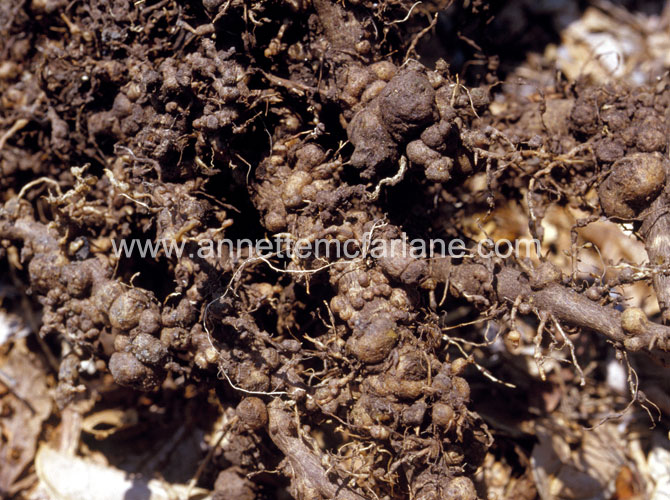
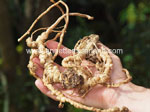
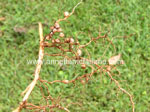
Root knot nematodes are the most common and obvious.
They cause root galls and excessive root branching. This
affects the plant’s ability to take in water and causes
wilting and stunted growth. Sandy soils and those low in
organic matter are prone to nematode infestation.
Incorporate home made compost or composted animal manure
into soil, grow nematode resistant varieties, rotate
crops and pay attention to hygiene.. For severe
infestations in vegetable gardens drench with black
strap molasses (2 tablespoons per litre of water). Apply
at planting to susceptible crops (tomatoes, potatoes,
chilli and capsicum).
|
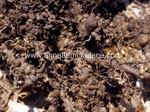 |
 |
|
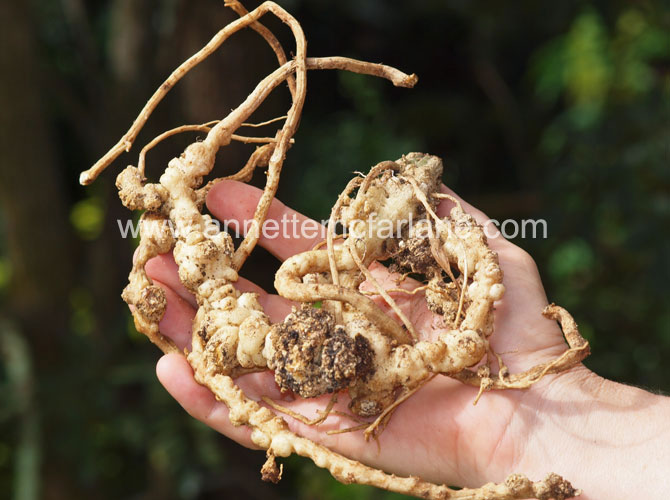
Root
knot nematodes should not be confused with beneficial
nitrogen fixing nodules common to peas, beans and other
legume plants. A significant distinguishing feature is
that root knot nematodes are white in colour then the
nodules are broken in half. Beneficial nitrogen fixing
nodules are pale pink through to pale red in colour when
broken in half. Plants that form these nodules do so as
a result of an association with soil organisms. This
relationship enables them to convert nitrogen from the
soil air into a form of nitrogen that can be used by
plants. Nitrogen fixing plants are a mainstay of organic
gardening.
|
 |
|
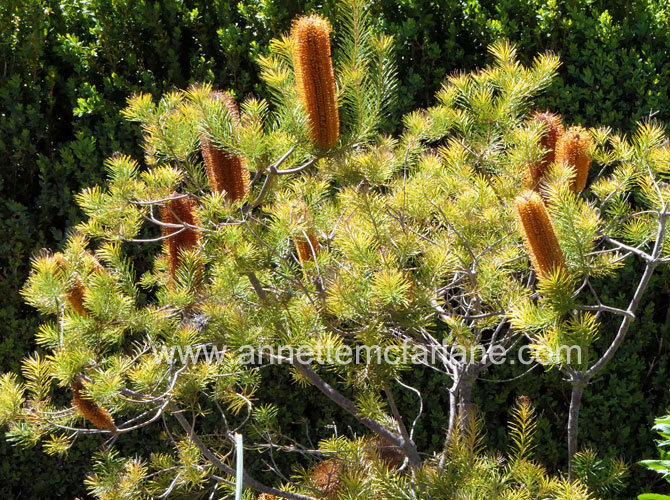
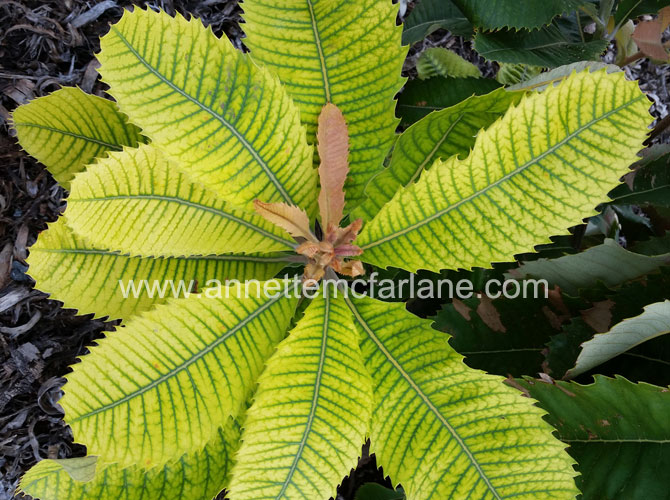
  Phosphorous
induced iron deficiency Phosphorous
induced iron deficiency
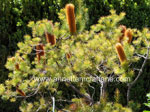
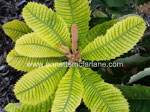
The proteaceae family which includes grevillea, banksia,
hakea and macadamia amongst others are sensitive to
phosphorous. Symptoms occur six to twelve months after
planting or after the application of high phosphorous
products like chicken manure based fertilisers and
compost and mushroom compost. Applications of iron
chelates watered around the roots will provide the iron
that the banksia needs. Recovery will depend on how the
plant has deteriorated prior to application. Raising the
soil to pH 6.5 by adding a little Dolomite lime to the
soil will also help. |
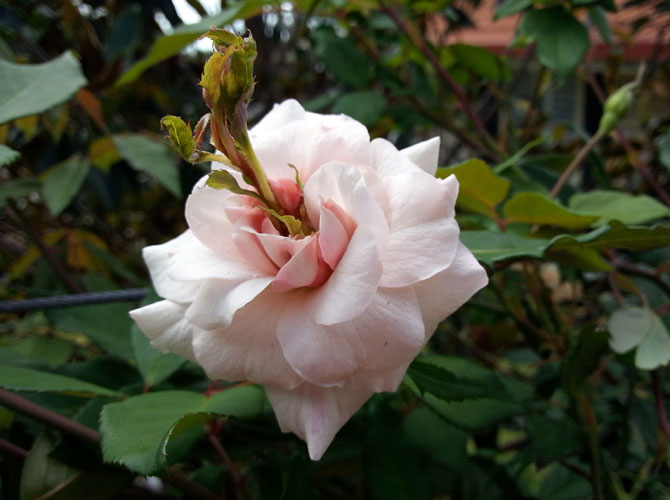
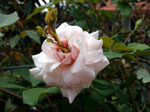 Phyllody Phyllody
This is a flower curiosity. Roses, gerberas and other
plants produce occasional abnormal flowers where leaves
or even completely new stems replace petals in a bloom.
A number of factors cause this deformity including
latent viruses, phytoplasmas, bacterial and fungal
diseases or extreme environmental conditions. Some rose
cultivars are susceptible to phyllody due to their
breeding genetics. Think back over the growing season
and try to link the appearance of phyllody to a
particular period of environmental stress and remedy
this in coming seasons if possible.
|
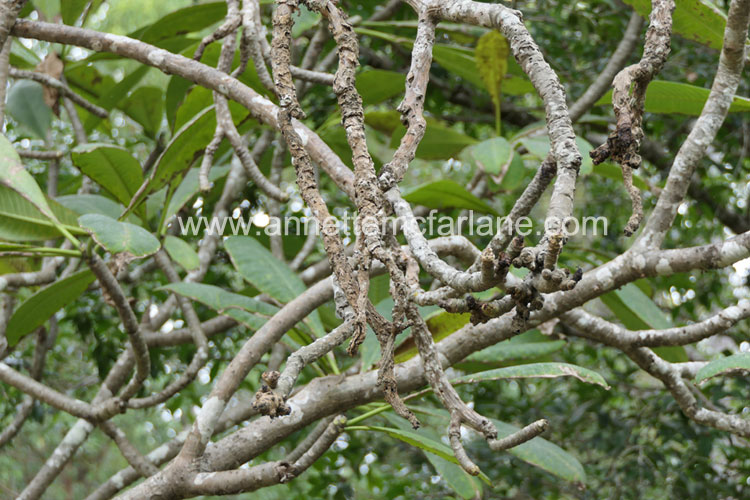
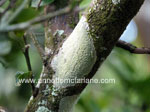 Pinks disease Pinks disease
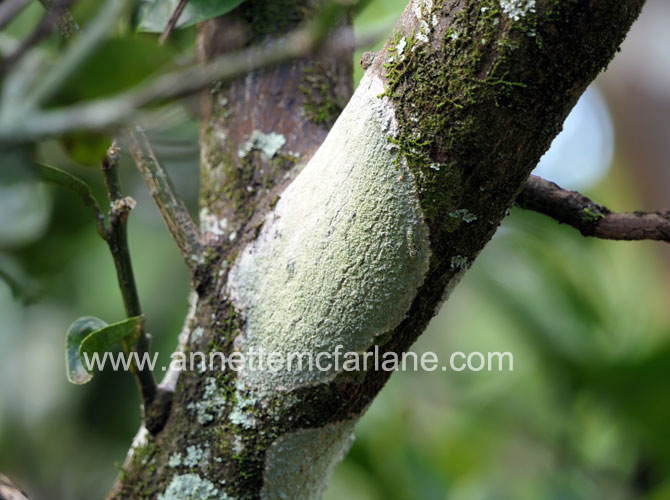
Erythricium salmonicolor or pinks disease is a
debilitating fungal disease of both productive and
ornamental trees. It is often mistaken for lichen. Limbs
display sunken circulator patches (lichen is flat or
slightly raised) often with a slight pink crusted tinge.
Affected limbs are prone to dieback and decay.
High rainfall and humidity favour disease development.
Prune infected branches and seal pruning cuts with tree
wound dressing or a copper-based tree paste. Prune to
increase air circulation and sunlight. Dispose of
prunings offsite. Spray trees with a copper-based spray
immediately after pruning taking care to treat the
entire plant including the trunk and branched. Provided
balanced nutrition to trees including adequate calcium,
silica and potash. Citrus and custard apples are
commonly affected. |
|
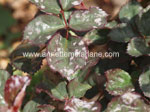
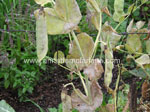
Powdery Mildew
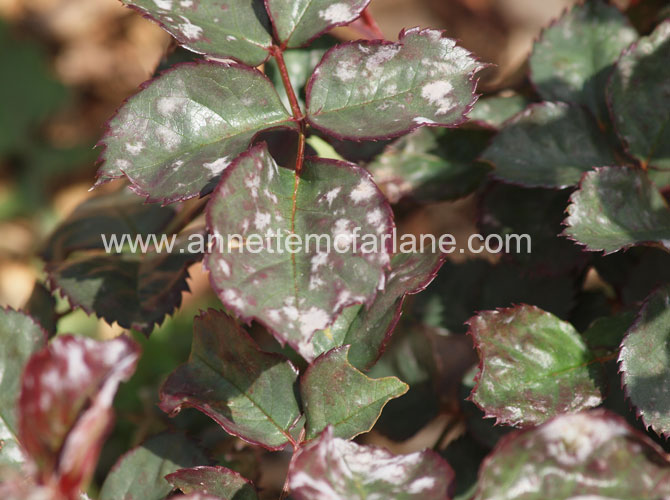
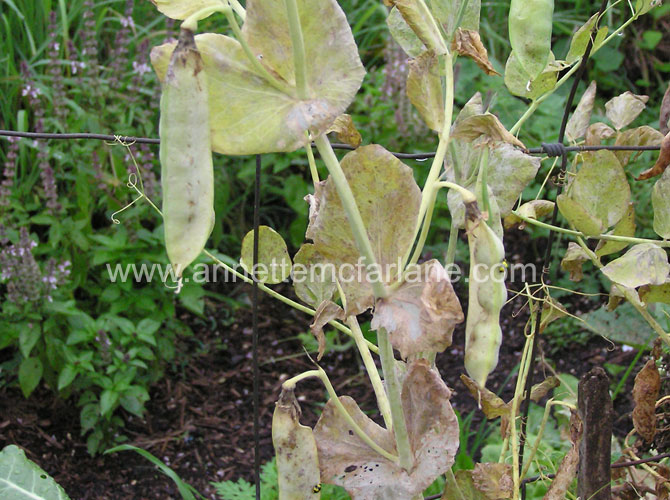
Powdery mildew is caused by a group of Ascomycetes fungi
and affects a wide range of plants including azaleas,
salvia, roses (caused by Sphaerotheca pannosa), azaleas,
vegetables (especially peas and cucurbits) and fruit
(especially apples and grapes). Affected growth
initially looks as though it is lightly covered with
talcum powder; leaves become progressively puckered and
finally appear burnt. Spores are present in air and soil
and tend
to germinate in cool, damp or humid conditions
(particularly over-night). Plants overly fed with
nitrogen are more susceptible as are those grown in the
shade or with poor air circulation. Avoid wetting plant
foliage.
Remove affected foliage. Increase exposure to
sunshine and improve air circulation around plants.
Reduce use of high nitrogen fertilizer.
Grow strong
plants by using balanced nutrition. Apply liquid
seaweed; bicarbonate of soda, milk or casuarina spray [see
Homemade pest control],
wettable sulphur, dusting sulphur or commercial liquid
silica and potash. Potassium bicarbonate sprays like
Eco-Carb or Eco-Fungicide are also effective. Yellow,
mildew eating lady bugs (Illeis galbula) and their
larvae eat powdery mildew and assists in controlling the
disease. |
 |
 |
|
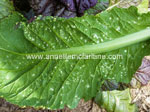
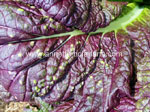
Rust
Rust describes a group of fungal organisms that cause
rust-like lesions on foliage. Initial symptoms appear as
white, yellow, orange or brown pustules on the undersides of
the foliage, progressing to circular yellow leaf
markings on the top sides of leaves, followed by leaf
drop. The disease worse during periods of high humidity,
mist and rain, because spores need moisture to
germinate.
Spores travel through the air and also via water splash.
Plants may be infected without showing symptoms, then
suddenly deteriorate when conditions change. Rust
diseases often attack a single host plant or group of
related plants. Rust on one plant will not necessarily
infect neighbouring plants of a different species. Rust
affects roses (Phragmidium tuberculatum); canna (Puccinia
thaliae); day lilies (Puccinia hemerocallidis) and
geraniums (Puccinia pelargonii-zonalis) are particularly
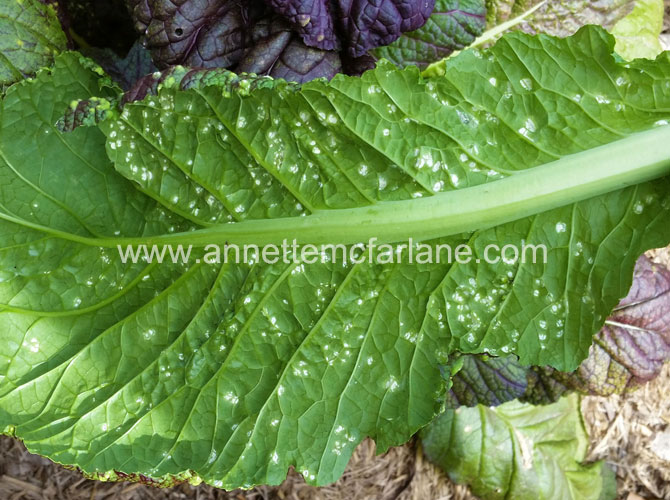
prone to rust. White rust on spinach results from
infection by Albugo occidentalis and causes raised white
rust pustules on spinach leaves. Remove the infected
leaves. Remove infected leaves, avoid overhead watering;
improve air circulation and exposure to sunshine.
Commercial potassium bicarbonate sprays like
Eco-fungicide may provide some protection for
susceptible plants. |
 |
 |
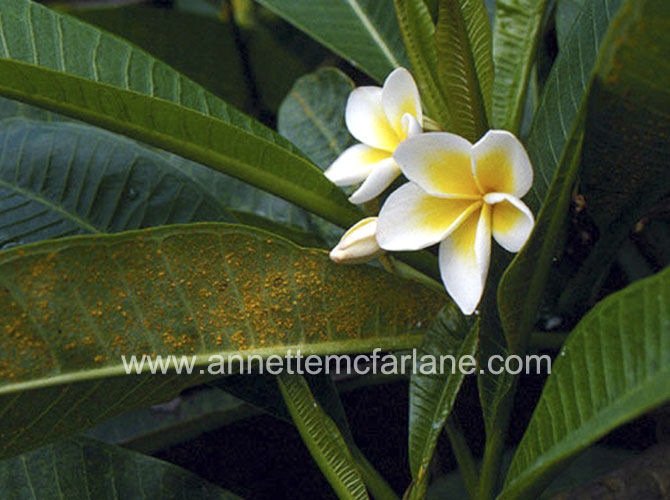
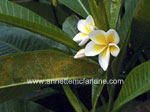 Rust on frangipani Rust on frangipani
Infected frangipani plants develop bright yellow rust
pustules on the undersides of leaves. This detracts from
the appearance of plants and causes premature leaf drop.
Frangipani trees that are severely affected year after
year can be weakened, but the disease is rarely fatal.
Rainfall and high humidity increase the incidence of the
disease. Plants grown in warm north facing, full sun
positions are less susceptible. Protective copper-based
sprays can be applied when trees first come into leaf,
but are largely ineffective if conditions favour the
disease or once rust symptoms become evident. Collect
and remove fallen leaves. Neighbouring trees that are
infected will provide a wind borne source of fungal
spores. |
|
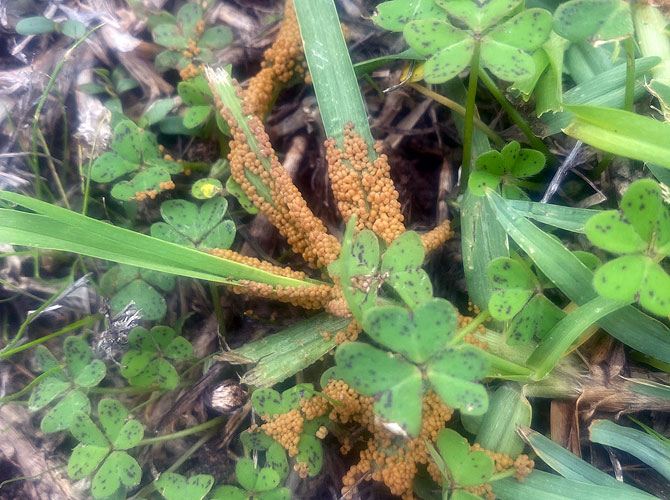
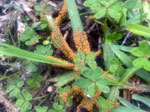 Rust on lawns Rust on lawns
Puccinia fungi cause rust on lawns. Susceptibility
increases when growth slows and humidity or soil
moisture levels are high. Reduce lawn watering. Add
gypsum to improve the drainage. Increase available
sunlight to lawn where possible by pruning trees causing
shading. Avoid high nitrogen fertilizer applications
during periods of slowed growth. Lawn rust is generally
not fatal and will disappear when the conditions change.
Applications of potassium bicarbonate based sprays like
Eco-fungicide may help.
|
|
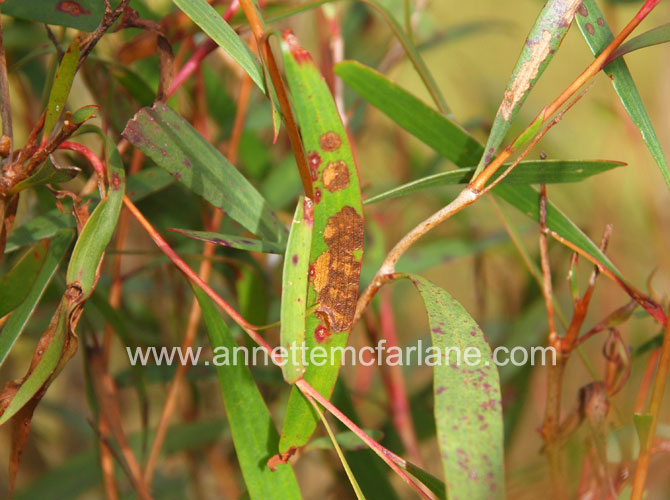
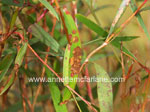 Rust on myrtaceae – Myrtle rust (Austropuccinia
psidii) Rust on myrtaceae – Myrtle rust (Austropuccinia
psidii)
This exotic fungus was first detected in NSW during
2010. The spread of rust spores is almost impossible to
control and attempts to eradicate myrtle rust have
failed. This disease potentially affects all native
myrtaceae including eucalyptus, callistemon,
Chamelaucium uncinatum (Geraldton wax), melaleuca, tea
tree, backhousia etc. Commercial growers manage this
disease with strict nursery protocols and fungicide
sprays. Propagation of naturally resistant plants is the
focus of commercial operations. Home gardeners should be
prepared to accept some damage particularly during hot,
humid weather. Remove highly susceptible species. |
Scab
Scab describes the appearance of several different
fungal diseases that create crusted lesions on a range
of fruiting and edible crops. Citrus, mango,
passionfruit and potatoes are particularly susceptible.
|
|
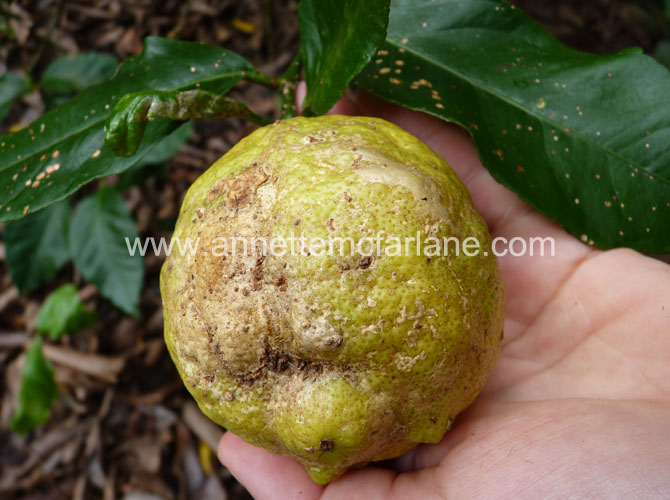
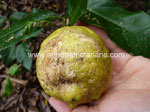 Scab on citrus Scab on citrus
This fungal disease potentially attacks all citrus, but
lemons are most susceptible. The disease does not really
affect fruit flesh, but the rind is unattractive and
fruit often become mis-shapen. Where infestations are
severe, the foliage may also develop scab lesions. Prune
off and dispose of infected fruit; clean up fallen fruit
and prune twiggy and dead growth that harbours fungal
spores. Improve the health of the plant by supplying
additional nutrition and spray trees with copper-based
products after fruit harvest to control outbreaks.
Scab on mango is caused by the fungus Denticularia
mangiferae causes shot hole effect on leaves and lesions
on fruit. Rainfall and high humidity increase the
incidence of the disease. Take preventative action by
pruning to improve air circulation and applying balanced
nutrition.
|
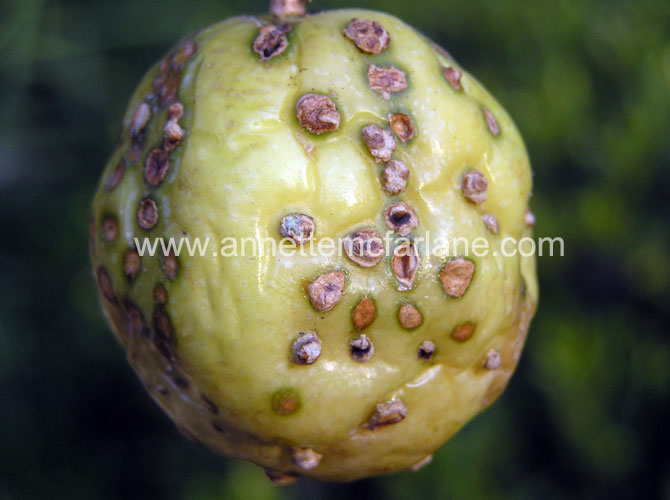
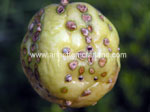 Scab on passionfruit Scab on passionfruit
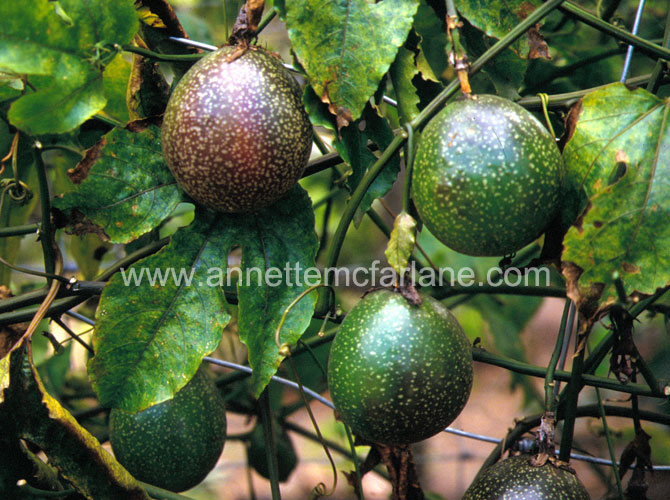
Cladosporium oxysporum results in passionfruit and
granadilla developing scab encrusted lesions on fruit.
Heavy infestations (like the one pictured) cause fruit
to shrivel and drop prematurely. Vines grown in shaded
areas and those allowed to grow to thickly are
susceptible. Always grow vines in full sun. Prune and
train vines to improve air circulation. Avoid wetting
the leaves. Remove and dispose of infected fruit
(offsite). Look for resistant varieties. Take
preventative action by applying a copper-based
fungicide. This disease may be confused with the fungus
disease Septoria passifloricola, but preventative
actions are similar. |
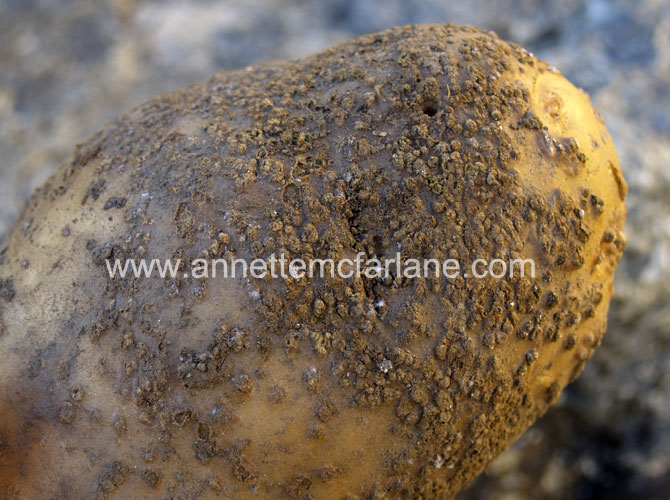
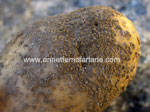 Scab
on potatoes Scab
on potatoes
This fungal disease is commonly introduced by using
non-certified seed potatoes (or saving seed from
previous crop) and is worse in alkaline soil and dry
conditions. Prepare a new area for your potatoes, ensure
the pH is not above 6, use certified disease free seed
potatoes and rotate crops each season. Potatoes,
tomatoes, capsicum and eggplants are related crops and
should not be planted after one another in the same
garden bed. Certified disease free seed potatoes are
available from nurseries, produce stores or online. |
|
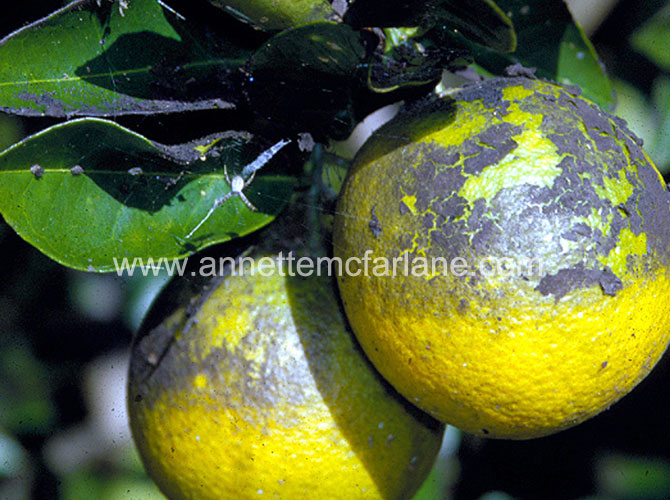
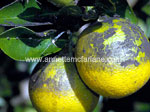 Sooty Mould Sooty Mould
Insects with piercing and sucking mouthparts like scale,
aphids and mealy bugs plus ants that protect and feed on
their secretions are commonly associated with sooty
mould. Sooty mould is a black fungus that grows on the
secretions produced by insects and will disappear once
the insects that produce these secretions are
controlled. Citrus, gardenias, lillypilly hedges and
fine leafed native plants are susceptible.
Use baits and repellents to control ants. Manually
remove heavy infestations of sucking pests like scale
from stems with a nail brush. Apply three applications
of home made [Do It Yourself Controls - Oil Spray] or
commercial oil sprays at fortnightly intervals. Dilute
to half strength on fine leaf natives or plants with
hairs on the leaves. Home made [Do It Yourself Controls]
and commercial soap sprays can be used on plants
sensitive to oil sprays, but should be used twice a week
for six weeks.
|
|
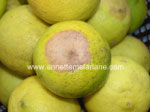 Stylar End Rot Stylar End Rot
This disease affects Tahitian limes and occurs when
fruit is left to over-ripen on the tree. The base of the
fruit develops a soft rot as the internal flesh begins
to break down. Fruit eventually falls to the ground. The
internal flesh also shows deterioration when cut. Fruit
should be harvested while still green in colour prevent
this occurring. Fruit should be harvested and stored
under refrigeration, rather than leaving it to hang for
excessively on periods on the tree.
|
|
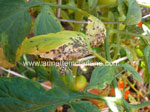 Target
Spot Target
Spot
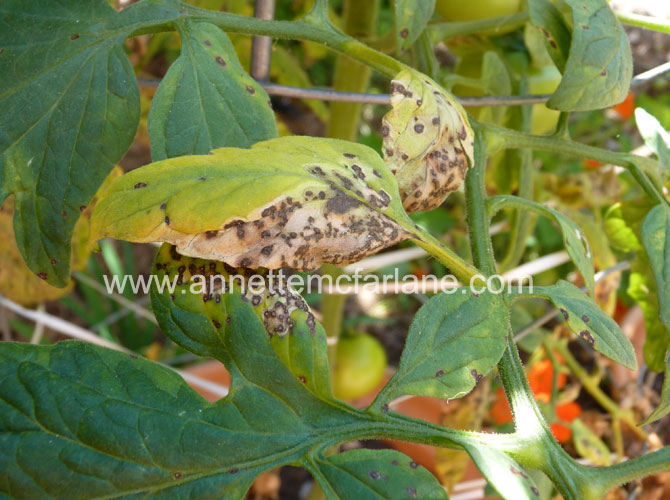
This disease affects a range of plants, but tomatoes are
particularly badly affected. Some varieties are more
susceptible than others and wet conditions (especially
rain or overhead watering) invite disease outbreaks.
Build strong healthy grow by adding gypsum (to supply
calcium) and trace elements to soil or potting mix at
planting and applying liquid seaweed during the growing
season. Eco-fungicide and copper-based fungicides can
help limit outbreaks. Train plants up to improve air
circulation around the foliage. Do not let the lower
foliage come in contact with the soil and prune off and
dispose of affected leaves. Deterioration of the lower
leaves of tomatoes is to be expected during the lifespan
of a tomato. These leaves represent natural aging and
should be removed. |
|
 Virus Virus
Virus diseases are transferred via infected seed,
cuttings and grafting and by aphids or other sucking
insects. To avoid this problem, never save seed from
plants that show poor growth or other symptoms that may
indicate potential disease problems. Remove and destroy
infected plants to prevent the possible spread by insect
vectors to neighbouring plants. Where possible plant
only certified seed potatoes and virus free
strawberries.
Virus diseases in plants often present as angular leaf
yellowing and poor growth.
Some latent viruses do not show obvious leaf symptoms,
but affect growth and productivity (potatoes). Cucurbits
are particularly prone to virus diseases, but they also
occur in roses and camellias. |
|
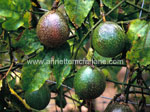 Woodiness virus on passionfruit Woodiness virus on passionfruit
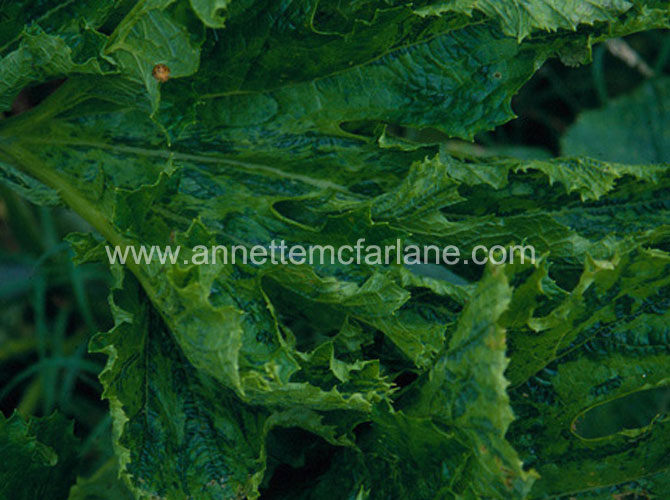
Affected vines show characteristic mosaic leaf
yellowing. This disease is often present in plants from
an early age, but only begins to gain the upper hand
when the vine becomes productive or is stressed in some
way. Affected vines may continue to grow, flower and
fruit, but will always lack vigour. There is no cure for
virus affected plants. Remove vines. Given their rapid
growth rate, high productivity and short lifespan,
passionfruit vines should be replaced every few years.
Plant new vines in a different part of the garden.
|
|
Wilt
The fungus Fusarium oxysporum is a common cause of wilt
disease. This disease is persistent in the soil and can
be introduced via contaminated plants or seeds. Tip
dieback and death of susceptible species is common.
Cutting stems of suspect plants longitudinally reveals
discolouration associated with blocking of the vascular
or water conducting tissue in plants. Choose disease
resistant varieties. Avoid saving seed from plants that
die prematurely or are otherwise suspected of suffering
from disease.
Please note plants also wilt and die from overwatering,
attack by root knot nematodes, attack by curl grubs or
use of overly rich manure and/or excess fertilizer. |
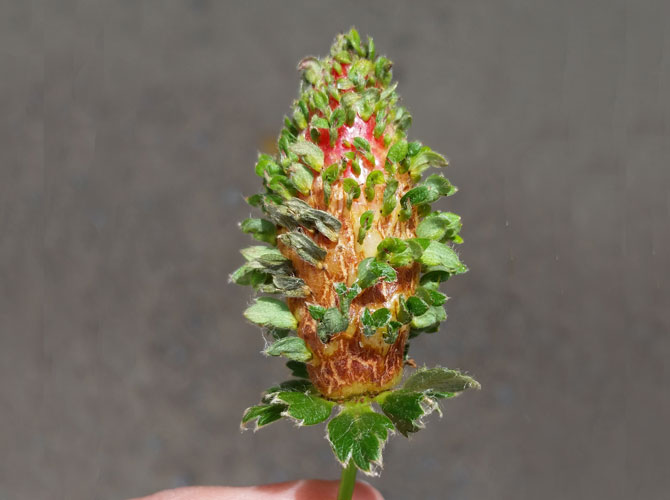
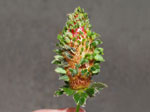 Vivipary/Pseudo
vivipary on strawberries Vivipary/Pseudo
vivipary on strawberries |
|
Top of Page
[Privacy
Policy]
© Copyright Annette McFarlane 2007-
All Rights Reserved |